Department of Electrical Engineering
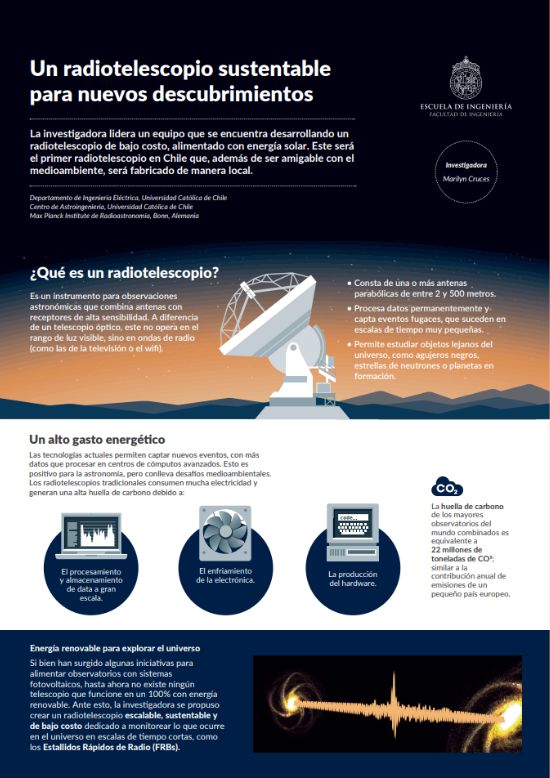
Today, observatories in Chile and around the world use a wide range of instruments to study the universe. While conventional telescopes work by capturing light signals, radio telescopes are large antennas designed to detect radio waves, a type of electromagnetic radiation that travels through space at the speed of light, similar to the waves we use to receive Wi-Fi. Through these instruments, we can observe certain phenomena that would otherwise be impossible to perceive.
Radio telescopes commonly consist of one or more parabolic antennas, which can range from 3 to 500 meters in diameter. They process data continuously, without interruption, which enables them to capture both events whose evolution unfolds over millions of years and other unexpected, fleeting phenomena. They are especially useful for studying phenomena such as black holes and planets in formation, located very far from Earth. In addition, unlike optical telescopes, which depend on visible light, radio telescopes can observe the sky both day and night, and even under adverse weather conditions, since radio waves can pass through clouds and do not depend on clear skies.
However, these instruments face a critical challenge: their enormous energy consumption. This is because data centers are needed to process and store vast amounts of information, requiring large amounts of electricity both to manage the data itself and to cool the machines.
In response to this scenario, a research team led by Marilyn Cruces, from the School of Engineering at Universidad Católica, is developing the first radio telescope powered solely by solar energy, built in Chile at low cost and with the potential to be scalable.
Designing Frontiers
Currently, there is no telescope that operates entirely on renewable energy. To carry out this project, which they named “Frontiers”, the research team defined two lines of work:
1.-Optimize data center operations:The researchers aim to improve the algorithms that process the data, making these centers more efficient and, therefore, reducing their energy consumption. They are also addressing the challenge of data storage: it is impossible to store the enormous volume of information captured by radio telescopes, so the goal is to preserve the minimum amount of data needed to later recreate the originals, if necessary. At the same time, the team seeks to develop a collaborative way of working among different observation instruments, so that they can send alerts to one another in the event of a discovery and complement each other’s functions. This lightens the workload of each radio telescope and strengthens scientific development.
2.-Reformulate the design to make it more sustainable: In addition to incorporating solar panels, the researchers seek to optimize the hardware design to reduce electronic noise without the need for cryogenic cooling, which is typically used to reach temperatures close to absolute zero.
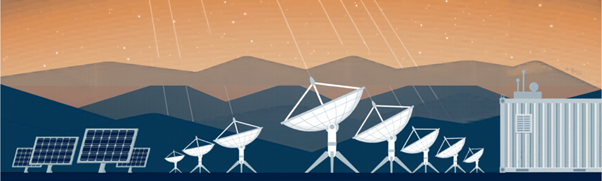
The research team is building a Frontiers prototype at the UC Observatory in Santiago. It will include the observation antennas (center), solar panels that supply 100% of the system’s energy (left), and a container housing the computers that process the data (right).
The research team is currently developing and testing the Frontiers prototype at the Universidad Católica Observatory, located in Lo Barnechea, Santiago. At this stage, the scientists are working on the installation and validation of the electronics associated with the antennas, which will be part of a system designed to receive signals from distant galaxies and capture very short-duration events, in the order of microseconds.
The project envisions a set of three-meter-diameter antennas, along with a container that will house the computers responsible for processing the data. It will also incorporate solar panels with the aim of moving toward energy-autonomous operation, capable of powering the radio telescope’s equipment.
This energy autonomy will be complemented by operational autonomy, as the instrument is being designed to be operated remotely. Its modular structure will also allow the system to be progressively expanded through the incorporation of new antennas, solar panels, and computers.
Department of Electrical Engineering
Among the project’s next challenges are expanding the radio telescope to around 100 observation antennas, along with the corresponding number of solar panels, and defining the final site for its installation. The team is currently exploring different locations, both around Santiago and in the Atacama Desert, evaluating a combination of key factors: solar incidence, accessibility, and the level of electromagnetic isolation of the surrounding environment. In parallel, work continues to optimize the operation of the data centers.
Finally, Frontiers will not only make it possible to gather information from the far reaches of outer space in a sustainable way, but it may also become an object of study for researchers around the world. Added to this is its contribution to the development of local technologies, both within the University and through partnerships with national companies, strengthening local capabilities for the design, implementation, and operation of advanced scientific infrastructure. It is a project still under development that has already produced promising figures: it could be 42% more cost-effective than a telescope powered by a diesel generator, with a carbon footprint that is 95% lower.
Frontiers is being developed as an open-source project, meaning that any research team can access and use it free of charge. This contributes to a more collaborative approach to scientific development.

From the outset, Frontiers was conceived as a scalable project; in other words, one whose design could be reproduced or even expanded at other research centers. In line with this, the prototype and software will be open source, making them available at no cost for any team to study and use.
Open and Scalable Science

Department of Electrical Engineering
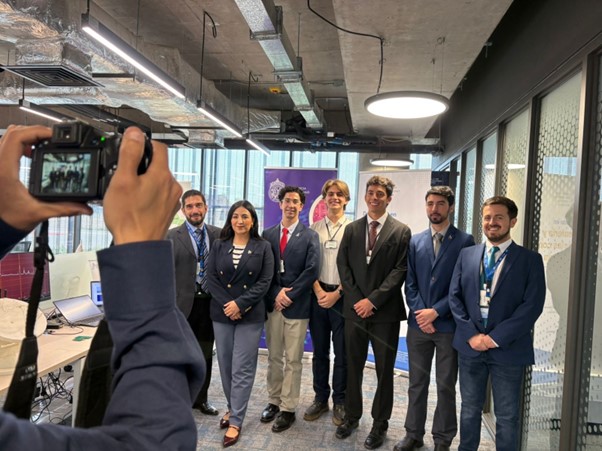
The research team developing Frontiers during their visit to the National Space Center, where they were invited to present their developments.