In the digital age, many organizations no longer face a lack of information. On the contrary, most of them generate enormous volumes of data about their operations every day. The real challenge comes afterwards: how can all that information be turned into concrete, timely and efficient decisions?

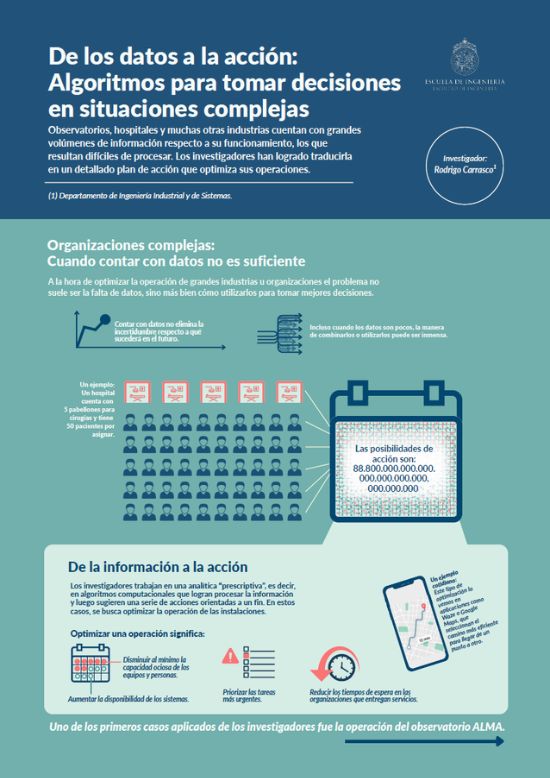
Even when the amount of data seems manageable, the possible courses of action can be far greater. In this example, there are 5 hospital operating rooms and 50 patients to assign. The number of possible courses of action is 88,800,000,000,000,000,000,000,000,000,000,000.
To address this challenge, Professor Rodrigo Carrasco, from the UC School of Engineering, leads a line of research aimed at optimizing the operation of complex organizations through algorithms. His work focuses on so-called prescriptive analytics, an approach that processes information and suggests actions aimed at achieving a specific objective.
The logic can be compared to apps such as Waze or Google Maps: based on data about routes, travel times and traffic conditions, the system recommends the best way to reach a destination. Similarly, the models developed by the researchers can suggest plans to make an organization’s operations more efficient, taking into account its constraints, priorities and available resources.

Optimizing an operation means meeting objectives such as minimizing the idle capacity of equipment and people, increasing system availability, prioritizing the most urgent tasks and reducing waiting times.
The ALMA case: data to anticipate failures and improve maintenance
One of the first applied milestones of this research began in 2015 at the ALMA Observatory, the large astronomical complex located in the Atacama Desert in northern Chile.
ALMA has an enormous amount of operational data. Its 66 observing antennas have about 130,000 monitoring points, which measure parameters such as temperature, voltage and pressure, among many others. Every day, these sensors generate around 50 GB of data on the observatory’s operation.
The first step is to turn that data into useful information through predictive analytics. This technique uses machine learning models —a form of artificial intelligence— to identify patterns in historical data and anticipate future events. In ALMA’s case, the models can predict up to 15 months in advance when a part of the infrastructure might fail or reach the end of its useful life, generating preventive maintenance alerts.
However, anticipating failures does not solve the problem on its own. A system like this can generate thousands of alerts a day, too many to manage efficiently by hand. This is where prescriptive analytics comes in: the goal is no longer just to predict what might happen, but to decide what to do, in what order and under what conditions.
Prescriptive analytics brings together several branches of engineering, such as computer science, business analytics, data science, operations research and, above all, mathematical optimization. The latter makes it possible to process the alerts while taking into account the real constraints of the operation, such as equipment availability, maintenance times, task urgency and service continuity.
In ALMA’s case, the model made it possible to develop a maintenance plan with prioritized, chronologically ordered actions. The plan was computed in just nine seconds, which means it can be updated quickly in response to unforeseen events or changes in operations.
In this way, the data captured by the antennas’ sensors is first transformed into information and preventive alerts through predictive analytics, and then into concrete decisions through prescriptive analytics.
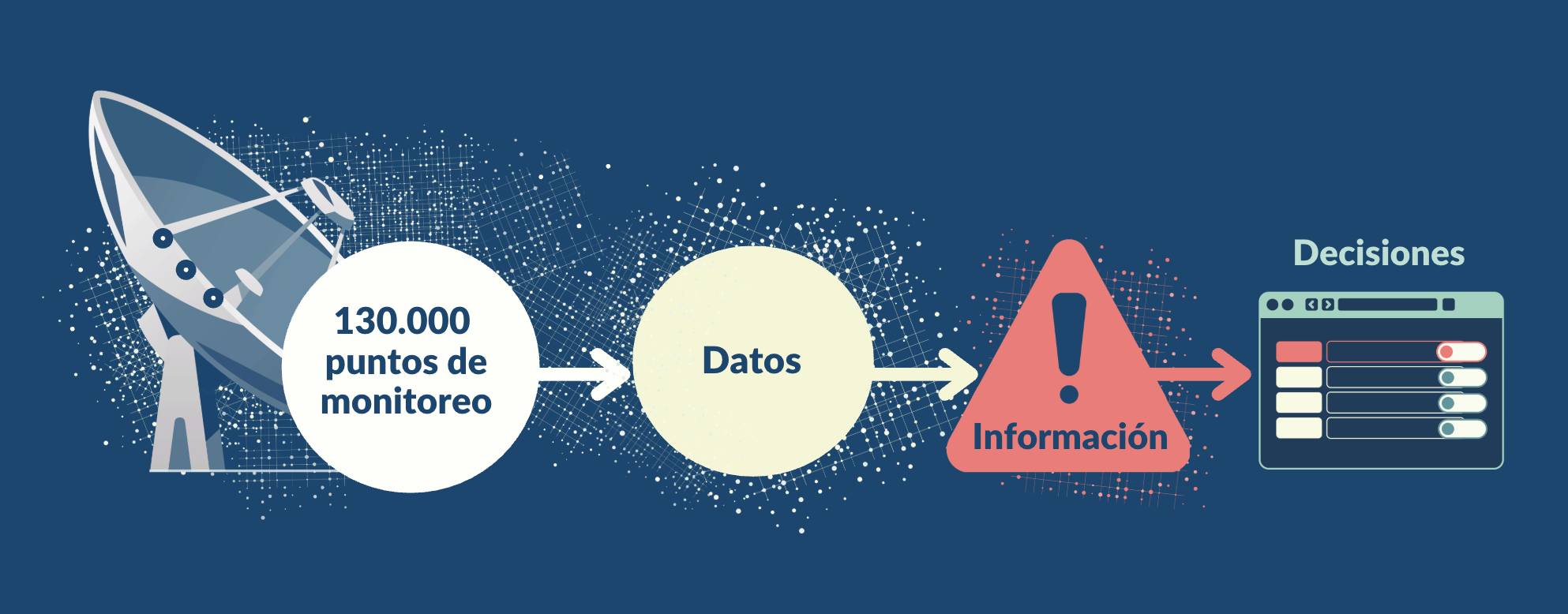
The research also made it possible to optimize how observation tasks are distributed among ALMA’s antennas, taking into account scheduled or unplanned maintenance work. This way, the observatory can keep operating even when some equipment is out of service for parts replacement or other reasons.
Department of Industrial and Systems Engineering, Institute for Mathematical and Computational Engineering
Prescriptive analytics models seek to find the best possible solution according to certain objectives and constraints. However, in some applications, especially when decisions directly affect people, an additional consideration arises: optimizing technical or economic variables is not always enough.
In these cases, it is also important to ask about the consequences of each decision: how it may affect people, what negative externalities it could create, or what aspects might be left out in the pursuit of maximum efficiency. Incorporating this dimension broadens the criteria that guide the algorithms’ recommendations and better adapts them to the context in which they will be applied.
That is why, alongside developing tools capable of improving complex operations, it is important to keep a critical eye on how algorithms are used. The question is not only whether a decision is mathematically optimal, but also whether it is fair, responsible and appropriate for the context in which it will be applied.
Considering these dimensions makes it possible to approach problems more holistically and to make better use of the potential of prescriptive analytics: turning large volumes of information into concrete actions, evaluating enormous numbers of alternatives and generating recommendations that would be very difficult to obtain through human analysis alone. In this way, these tools can contribute to more efficient decision-making, while also taking into account the particularities and needs of each context.
Beyond efficiency
But the potential of these models is not limited to astronomy. Prescriptive analytics can be adapted to many contexts where there are complex operations, abundant data and decisions that are hard to coordinate.
Today, this line of research has been applied in a variety of sectors. The airline LATAM, for example, has a maintenance plan for its aircraft built with prescriptive analytics tools. In the wine industry, Concha y Toro uses it to allocate beverages to bottling lines according to different formats. In hospitals, these models can support decisions such as assigning patients to beds, operating rooms and medical teams, taking into account the urgency of each case and the conditions available at any given time.
In all these examples, the underlying problem is similar: how to make better decisions when there are many variables, limited resources and significant consequences for the operation. And as these tools begin to be used in increasingly diverse contexts, an additional aspect comes into play: what criteria we use to define which decision is best.
Beyond the observatory